Objectives
In its third and final phase ABioSA will continue to contribute to development of a competitive, resilient, prosperous, inclusive and sustainable ABS-compliant biotrade sector in southern Africa.
Central to this ambition is strengthening the agency of SMMEs, associations and government actors so that they are not just recipients of support but also decision makers, innovators and carriers of change beyond the project.
The systemic competitiveness framework remains ingrained in the design of the project, and knowledge management becomes a vehicle for agency, equipping stakeholders with evidence, stories, and shared perspectives to act with confidence in a complex environment.
Systemic change often has a greater impact than direct assistance as even people/SMMEs with no immediate contact with the project will benefit indirectly.
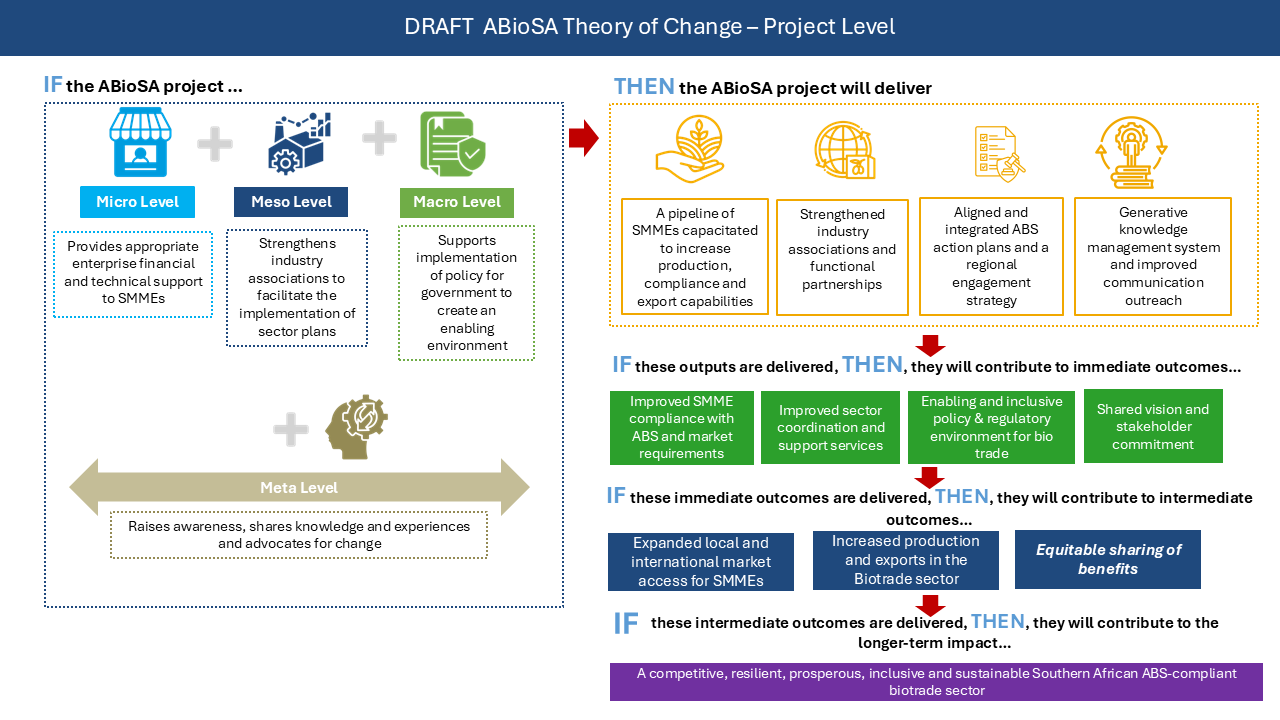
The Theory of Change (ToC) serves as strategic roadmap and communications tool for a development project. It illustrates the pathways through which the project’s activities contribute to meaningful and systemic change. Its message is relevant for communication with internal and external stakeholders and will help determine, during the close-out evaluation, whether the project’s intended impact has been achieved.
The ToC serves a threefold purpose:
- To explain the ToC by mapping the logical sequence from inputs and activities through outputs and outcomes to long-term impact.
- To outline the core assumptions underpinning the ToC. These include contextual, economic, environmental and implementation assumptions that must hold true for the project to achieve its intended outcomes.
- To present a results framework (logframe) – with clearly defined outputs, outcomes, impact statements and indicators. This logframe provides the basis for monitoring, evaluation, and learning, enabling the project to track progress, assess effectiveness, and generate evidence to inform adaptive management and stakeholder accountability during the implementation and close out phase.
Activities
Building on its previous two phases, ABioSA phase III will:
Provide appropriate technical and financial enterprise support to MSMEs
BioPANZA, in collaboration with ABioSA, aims to support MSMEs through a structured approach that builds capacity across the pipeline, using diagnostic assessment and referral tool within a supportive public and private environment.
The two-pronged tool will provide valuable information around:
- The maturity of SDP value chains based on end markets served.
- The maturity stages of the MSMEs’ business life cycle and their positioning within respective biotrade value chains.
This will generate four categories to profile MSMEs within these value chains. Each category will have a set of criteria that identifies key characteristics and positions the MSME for graduation from one category to another. The tool will indicate a referral pathway between the meso level organisations/BSOs within the biotrade sector and provide recommendations on what type of technical and financial public and/or private support is required in each of the categories.
ABioSA will outsource the project management of the business mentoring support programme to create the enabling conditions for doing business with selected MSMEs so they can be supported in the transition between categories. The service provider will apply the diagnostic assessment and referral tool to select transitioning MSMEs for the next stage of support. A BioPANZA reference committee will review the referrals from the service provider.
Based on the categorisation, ABioSA would like to test the technical and financial support across the various MSME categories, with the key focus being support for export ready and exporting MSMEs. The MSMEs from categories not supported by ABioSA will be referred to other BSOs. In the case of ABioSA this support will be offered within the context of the supported SDPs at Meso level where the associations will play a vital role.
Leaving behind a functional and tested assessment and referral tool, along with MSMEs able to access blended finance and technical support, creates a sustainable environment for a healthy biotrade ecosystem to build on.
Strengthen industry associations to facilitate the implementation of sector plans
The project supports the development and implementation of targeted sector plans for priority indigenous species for natural ingredients and finished products, facilitated by industry associations and BSOs. These plans are designed to institutionalise sector planning that will coordinate actors, mobilise resources and drive investment in value chain development.
The support is provided through technical and financial assistance based on the identified overarching SDP priorities.
As part of the ABioSA SDP M&E close-out process and the Quo Vadis review during Phase II, the associations have been reviewing their progress in SDP implementation, evaluating their outcomes and setting a strategic direction. Additionally, they have captured their achievements, challenges and lessons learnt in preparation for future partnerships and resource mobilisation.
In line with GIZ procurement requirements, calls for proposals to meso level organisations will be issued in Phase III. The call will be structured into three categories described under the output areas described below. The applicants will be requested to respond in line with the pillars of the SDPs namely:
- Sector management, governance and M&E
- Legislation and compliance
- Conservation and sustainable use
- Market access and generic marketing
- Quality, registrations and competitiveness
- R&D and innovation
- Traditional knowledge and community engagement (identified during the Quo Vadis review)
In addition to the financial support, technical support will be facilitated through expert and peer-to-peer learning exchanges on prioritised themes and topics aligned to the SDP pillars. In support of the programmatic MSME approach from Component 1, the associations will collaborate with the selected service provider to help relevant MSMEs understand sector-wide activities already addressed in the SDPs, as well as those that should be addressed at company level.
In return, the service provider will update the associations on any new or recurring patterns across the MSMEs within that value chain, to be aggregated for sector-wide action aligned with SDP work packages, or considered at the next SDP review.
This ensures that there is a symbiotic relationship between the micro and meso levels to create an environment that makes it easier for businesses to succeed in the private sector.
The project will leave behind coordinated and aligned sector actors with defined strategic plans for specific value chains which are able to leverage sector-wide interventions to enhance participation and raise competitiveness in the southern African biotrade sector.
Support inclusive strategic implementation with government to create an enabling environment for biotrade
A study conducted by the African Baobab Alliance (ABA) compared national ABS frameworks in the SADC region. It showed that South Africa is often lauded as a leader in ABS in Africa and in equitable access and benefit sharing case examples globally. NEMBA, BABS regulations and the NBES are in place in South Africa with multiple checkpoints established, including the patent office, ports of entry and exit, provincial permit issuing authorities, and the DFFE itself monitoring and enforcing ABS compliance. Additionally, the country boasts two industry-wide benefit sharing agreements for Rooibos and Buchu, with a Honeybush agreement in the pipeline. This positions the DFFE to present its unique approach and value proposition through engagement nationally, within the region, and with other southern African countries.
However, stakeholders often report that these regulations impose considerable and, in many cases, prohibitive costs and time burdens on both MSMEs and Traditional Knowledge holders seeking to become ABS compliance. This is a comparative economic disadvantage with a view to long term international market access as other (neighbouring) countries engaged in biotrade have no or less complex regulations. Relative uncertainty exists with regards to the draft Indigenous Knowledge Systems regulations under the DSTI, the draft NEMBA Bill and the draft NBES which is still under review. This makes it difficult to predict the broader conditions needed to strengthen the enabling environment. Other challenges are insufficient human resource capacity and the need for improved coordination among different governmental departments and stakeholders involved in the ABS process.
Over the past seven years the relationship between the ABioSA project and the DFFE has grown and allows for this component to focus towards a four-tier approach in support of the department to contribute to practical implementation of national, provincial and regional ABS frameworks responding to international commitments, such as the Nagoya Protocol.
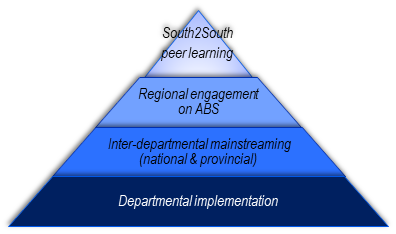
Leaving behind a strengthened institutional network equipped with tools at the end of the project phase to be able to maintain the exchange, learning and continued improvement of systems.
Use the knowledge management ecosystem to raise awareness, share knowledge and experiences, and advocate for change
In ABioSA Phase III, knowledge management becomes a cross-cutting enabler across micro, meso, macro and meta levels. At the micro level, knowledge management helps MSMEs capture lessons from diagnostics and market experiments. At the meso level, it supports associations and BSOs to spot patterns and coordinate responses.
At the macro level, knowledge management provides evidence to guide regulation and policy adjustments. At the meta level, knowledge management strengthens shared language, trust, and memory across government, academia, industry, and communities.
Knowledge management is not just about storing reports. It makes learning visible, creates feedback loops, and gives stakeholders early warning signals so they can adjust direction.
Knowledge management supports continuity by ensuring that collective learning is not only documented but becomes part of how organisations work and decide. This directly supports ABioSA’s sustainability and long-term value creation — leaving behind not only tools and networks, but also an adaptive culture of collaboration.