ABioSA has a toolbox of approaches it uses within its implementation of project activities. These approaches have been influenced, informed and shaped over the two previous project phases. None of these approaches is unique on its own, but we believe that intentionally bringing them together is what makes ABioSA different.
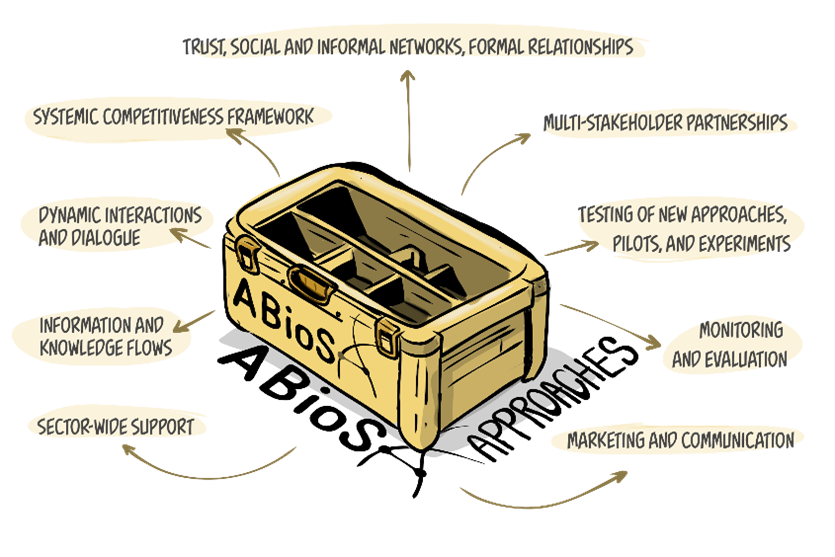
In the ABioSA toolbox we apply the following approaches:
Systemic Competitiveness Framework
Sectoral competitiveness and economic growth within the broader national system traditionally focused quite narrowly on a few determinants of economic performance. The Systemic Competitiveness Framework applied by ABioSA concentrates on four social and economic levels and the way in which they interrelate. These are Micro, Meso, Macro and Meta levels.
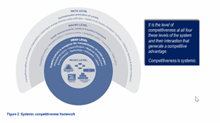
The framework recognises the importance of working at all four of these levels to strengthen African biotrade with interventions that respond to the needs of the whole sector.
- Micro: smallest level of economic activity consisting of enterprises, their organisational structures, and how they interact with each other to simultaneously achieve efficiency, quality, flexibility and speed of response.
- Meso: where both public and private meso organisations at national, regional and local level become involved in promoting business. Targeted meso policies, support initiatives and concrete projects are established to coordinate and promote sector advantages and increase relative competitiveness.
- Macro: where pressure is exerted on the enterprises through performance requirements and policies across the economy.
- Meta: comprising strong foundational legal, political and economic structures, along with the social capacity for organisation and integration, and the ability of the actors to achieve strategic integration. At a meta level, ABioSA is helping to adjust and transform established beliefs and perceptions around key topics such as ABS and gender equality. The project encourages collective learning, capacity building and development within the biotrade sector.
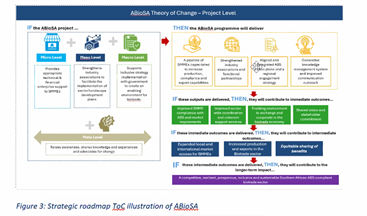
ABioSA is not only striving for direct impact, but it operates to contribute to systemic change. Systemic change often has a greater impact than direct assistance; even people or MSMEs with no immediate contact with the project will benefit.
ABioSA does not only focus on inputs, outputs and direct impact – although these are important. We are also interested in the dynamic interactions between stakeholders across these four levels, and how these interactions translate into investments in activity outputs. These are key to translating the inputs into outputs; and moreover, they offer key insights into the lived experience of both value chain actors and supporters. Through these interactions, the ABioSA implementing team learns how information flows, problems are solved, knowledge is generated, and learning occurs within a sector. And we learn how to adapt our support in return.
Interaction between stakeholders at the different levels are often influenced by issues such as trust, social and informal networks, formal relationships, shared customers, shared inputs and other contextual factors. The project uses different tools and approaches to facilitate and encourage breaking down silos and more collaborative ways of working.
ABioSA, in collaboration with other partners, aims to bring together different stakeholders within the Systemic Competitiveness Framework. These include industry (both MSMEs and associations), government, academia and civil society, working to create synergies between the different parties and to support the creation of an enabling environment for the biotrade natural products sector. Our ultimate mission is to yield increased market access, economic growth and job creation, and community inclusion within the sector. Together, we dare to create a space within the project to test new approaches, pilots and experiments.
Sector Development Plans
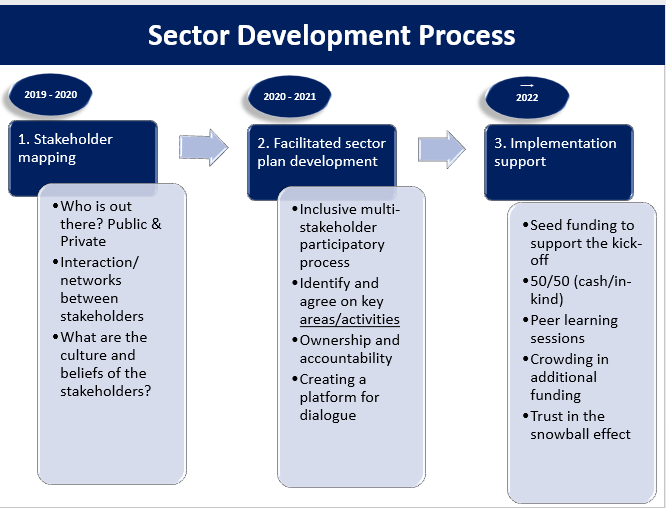
The purpose of the Sector Development Plans is to move all relevant stakeholders within a value chain in the same direction. Within the initial engagement during Phase I, stakeholders generated a short list of jointly agreed key strategic interventions and focus areas. These should be concrete action- and results-oriented activities with a budget breakdown, and owned by different stakeholders and institutions for implementation. They establish a platform for future high-level government and industry engagements to address problems and resolve disputes. In addition, they address “institutionalisation” for governance, coordination, and accountability across the spectrum of responsible stakeholders.
To support interaction and learning, ABioSA invests in platforms, workshops and the development of Knowledge Products.
Communication and engagement
ABioSA develops knowledge products to enhance the flow of knowledge and information. These knowledge products capture lessons learned, codify best practices and share insights that build the biotrade sector. They are already a legacy of ABioSA’s first two phases, and represent a narrative of institutional strengthening, regulatory engagement, research and market development across multiple value chains.
ABioSA harnesses communication for social and behavioural change, and is working to improve cooperation, collaboration and engagement with communities.
ABioSA supports two-way learning and knowledge sharing, and co-creation of initiatives.
A dedicated marketing, communications and PR service provider is crucial to the ABioSA approach and supports the development and design of knowledge products, events, project awareness and identity.
Events
ABioSA is known for its participatory approach to events, encouraging commitment and understanding that leads to collaboration and focused action. ABioSA is a founding partner of the African Biotrade Festival in collaboration with the South African government.
Its annual project steering committee meetings are attended by multiple stakeholders who contribute input and advice on future project implementation. During the last PSC meeting a SenseMaker exercise was conducted to get an alternative understanding of how participants perceive the value of the ABioSA platforms, events and knowledge products.
See what stakeholders had to say
ABioSA hosts the popular quarterly Biotrade Stakeholder Forum in partnership with UNIDO GQSP, and organises regular dialogues between industry, government and traditional knowledge holders.
Between 2023 and 2025 ABioSA piloted a series of workshops with the Honeybush community in the Western Cape.
Monitoring, Evaluation and Learning (MERL)
A M&E service provider was tasked with evaluating the overall project phase, as well as key initiatives such as the MSME support and sector-wide support. This supports efforts to identify verifiable sector data and support MSMEs and associations in building capacity in governance, management, processes and procedures, which often requires aggregated data derived from monitoring and reporting.